The Oculus Rift has
always been presented first as a gaming peripheral & all other
functions second (So far I've seen news about movies (3D and otherwise), virtual tourism, treatment of PTSD, virtual
medicine / surgery training and far more ideas than I could hope to dream up..).
This makes sense for many reasons. PC games are easily some of the most demanding applications for this (or any) kind of device, plus the fact that a virtual 3 dimensional space is already being used in most games, makes the transition that much easier. Most people use games as a form of escapism, the addition of something which enhances the effect will always find acceptance. New, relatively untested technologies with a lot of promise will have no trouble find buyers in this this group.
The advantage in designing the Oculus Rift for this kind of target audience is pretty obvious. If the device works well on the most demanding of games, odds are it'll be flawless in less stressful applications.
For me, the 'killer app', without which it'll be more of a toy is - vision correction. In other words - I should be able to use the Oculus Rift without prescription glasses. From what I understand, the Oculus software distorts the image edges to give the 110 degree FOV and for immersion. Hopefully this can be modified within the software. Seems like a logical step to take & I've heard both Palmer and Brendan mention this several times on interviews.
I have been keeping an eye on Google's news page for anything new about the Oculus Rift, as and when it turns up (hoping for a release date, really). A lot of weird news pops up there, good chunk of which is only vaguely connected to the Rift.
What I found really funny was a lot of people comparing the Rift with the Google Glass and more recently Microsoft's HoloLens. I'm struggling to comprehend how the two could be compared. The Rift is a full FOV VR display that cuts off pretty much all of your outside vision. Both Google Glass and the Microsoft HoloLens depend upon your normal vision being minimally compromised while the device adds something extra. AR, in short. Both the AR devices are meant to be worn and used while freely moving about your regular day. Both are far more expensive than the Rift. And since the Rift cuts off your outside vision, it would be mostly a seated experience. Comparing the Glass and HoloLens to each other makes sense, but the Rift? A whole other category. I wonder if it is ignorance or simply trying to combine 2 newsworthy items into a single article. What do you think?
There are even folks who predict that it'll flop, citing reasons like 'the device is ugly' and 'makes you look like dork' with a blank faced pair of ski goggles strapped to your face. Heh! Can't think of anyone who's going to buy those for looks... Not yet at least. Perhaps in a few generations. BTW, I'm willing to look like the world's biggest dork if I can get a CV1 right now. :) And there will probably be a line for it too. Embrace the dorkdom!
Once the 8K displays become common enough and the camera companies bring their optics know-how into the picture (can you say Nikon, Canon, Olympus etc?). My guess is that it's at least 3-4 years away from the 1st CV of the Oculus Rift hitting the shelves. By then the optics should be a choke point, which would prevent the device from become smaller and lighter.
At this point, the only thing I can be sure of, is that it will ship with a kickass legal disclaimer. There will be people falling over and bumping into things everywhere, when it finally starts to ship. :)
This makes sense for many reasons. PC games are easily some of the most demanding applications for this (or any) kind of device, plus the fact that a virtual 3 dimensional space is already being used in most games, makes the transition that much easier. Most people use games as a form of escapism, the addition of something which enhances the effect will always find acceptance. New, relatively untested technologies with a lot of promise will have no trouble find buyers in this this group.
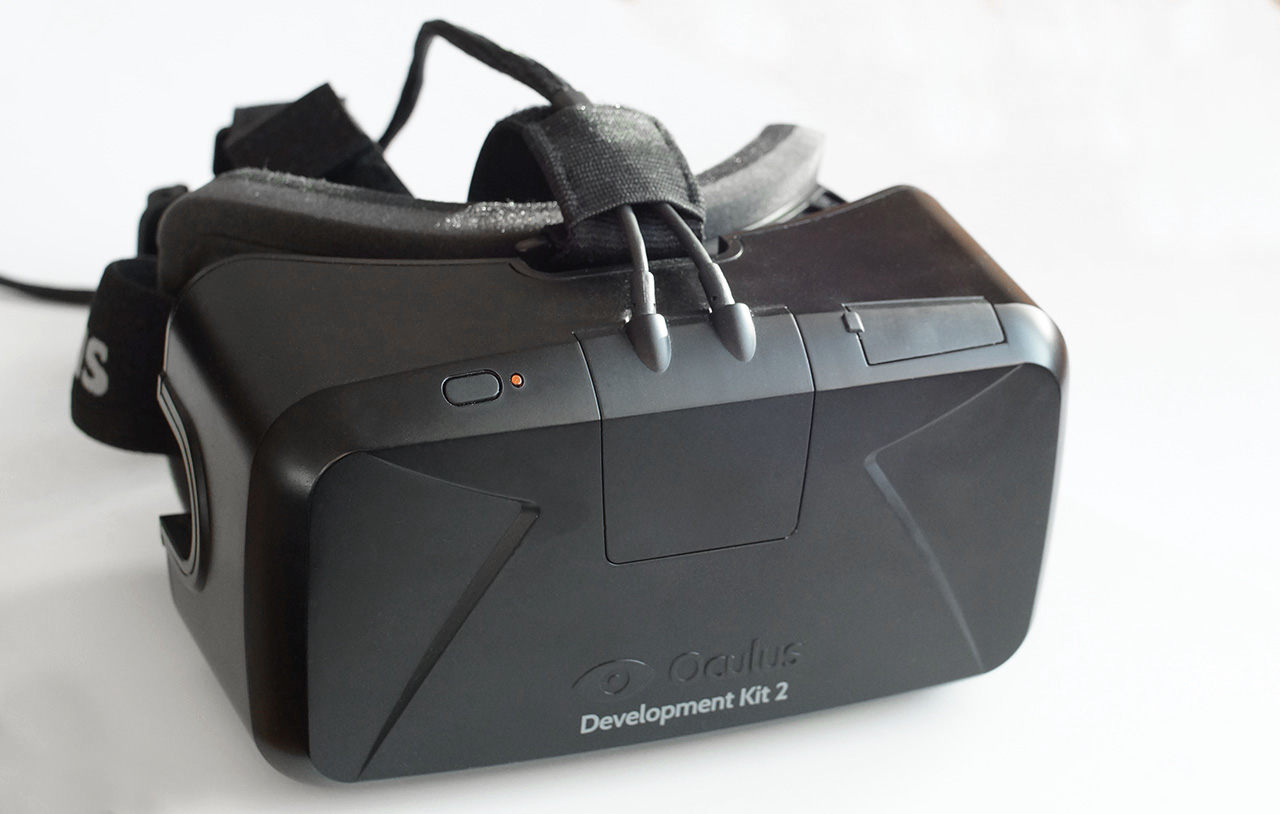 |
| The DK2. How many versions before it'll be wireless? |
The advantage in designing the Oculus Rift for this kind of target audience is pretty obvious. If the device works well on the most demanding of games, odds are it'll be flawless in less stressful applications.
For me, the 'killer app', without which it'll be more of a toy is - vision correction. In other words - I should be able to use the Oculus Rift without prescription glasses. From what I understand, the Oculus software distorts the image edges to give the 110 degree FOV and for immersion. Hopefully this can be modified within the software. Seems like a logical step to take & I've heard both Palmer and Brendan mention this several times on interviews.
I have been keeping an eye on Google's news page for anything new about the Oculus Rift, as and when it turns up (hoping for a release date, really). A lot of weird news pops up there, good chunk of which is only vaguely connected to the Rift.
What I found really funny was a lot of people comparing the Rift with the Google Glass and more recently Microsoft's HoloLens. I'm struggling to comprehend how the two could be compared. The Rift is a full FOV VR display that cuts off pretty much all of your outside vision. Both Google Glass and the Microsoft HoloLens depend upon your normal vision being minimally compromised while the device adds something extra. AR, in short. Both the AR devices are meant to be worn and used while freely moving about your regular day. Both are far more expensive than the Rift. And since the Rift cuts off your outside vision, it would be mostly a seated experience. Comparing the Glass and HoloLens to each other makes sense, but the Rift? A whole other category. I wonder if it is ignorance or simply trying to combine 2 newsworthy items into a single article. What do you think?
There are even folks who predict that it'll flop, citing reasons like 'the device is ugly' and 'makes you look like dork' with a blank faced pair of ski goggles strapped to your face. Heh! Can't think of anyone who's going to buy those for looks... Not yet at least. Perhaps in a few generations. BTW, I'm willing to look like the world's biggest dork if I can get a CV1 right now. :) And there will probably be a line for it too. Embrace the dorkdom!
Once the 8K displays become common enough and the camera companies bring their optics know-how into the picture (can you say Nikon, Canon, Olympus etc?). My guess is that it's at least 3-4 years away from the 1st CV of the Oculus Rift hitting the shelves. By then the optics should be a choke point, which would prevent the device from become smaller and lighter.
At this point, the only thing I can be sure of, is that it will ship with a kickass legal disclaimer. There will be people falling over and bumping into things everywhere, when it finally starts to ship. :)
